Nesta Money Saving Boiler Challenge
Energy Savings from Reducing Boiler Flow Temperature
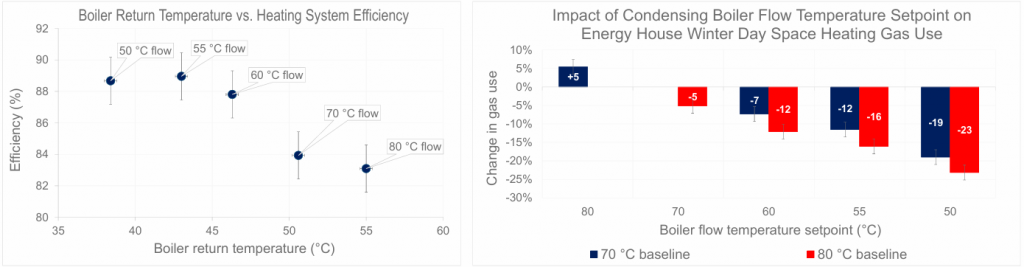
Condensing gas boilers operate most efficiently when the water returning from radiators is below 54 °C which allows heat to be recovered from flue gasses, this is known as condensing mode. However, many heating systems operate with flow temperatures that are too high and/or are poorly balanced, resulting in return temperatures above the threshold required a boiler to operate in condensing mode.
Nesta-funded tests undertaken at the Energy House demonstrated that lowering boiler flow temperature also lowers the return temperature, improving boiler efficiency and reducing gas consumption. Reducing the flow temperature from 80 °C and 70 °C to 60 °C delivered gas savings on a typical UK winter day of 7% and 12%, respectively. Further reductions below 60 °C produced only marginal efficiency gains while
substantially increasing room heat-up times.
Reducing boiler flow temperature is a low-cost intervention that can improve heating system efficiency and reduce energy use and carbon emissions
Research impact
- Nesta estimates that this measure could reduce
typical household gas use and energy costs by 8%The findings contributed to the evidence base that resulted in national campaigns (Nesta and the UKGovernment) encouraging householders to reduce their boiler flow temperature to 60°C. - According to an Ipsos survey, 27% of those with a condensing combination boiler have reduced their
boiler flow temperature. This is estimated to have resulted in annual UK gas savings of ~2,000 GWh, equivalent to 1.3% of total UK gas consumption, and CO₂e emission reductions of 366,000 tonnes.