This March, we were proud to celebrate a remarkable milestone: 45 years of accredited testing by our Thermal Measurement Laboratory (UKAS Testing Laboratory No.1660). For over four decades, the lab has been at the forefront of delivering trusted, high-quality thermal data to industry, government, and research communities across the UK and beyond.
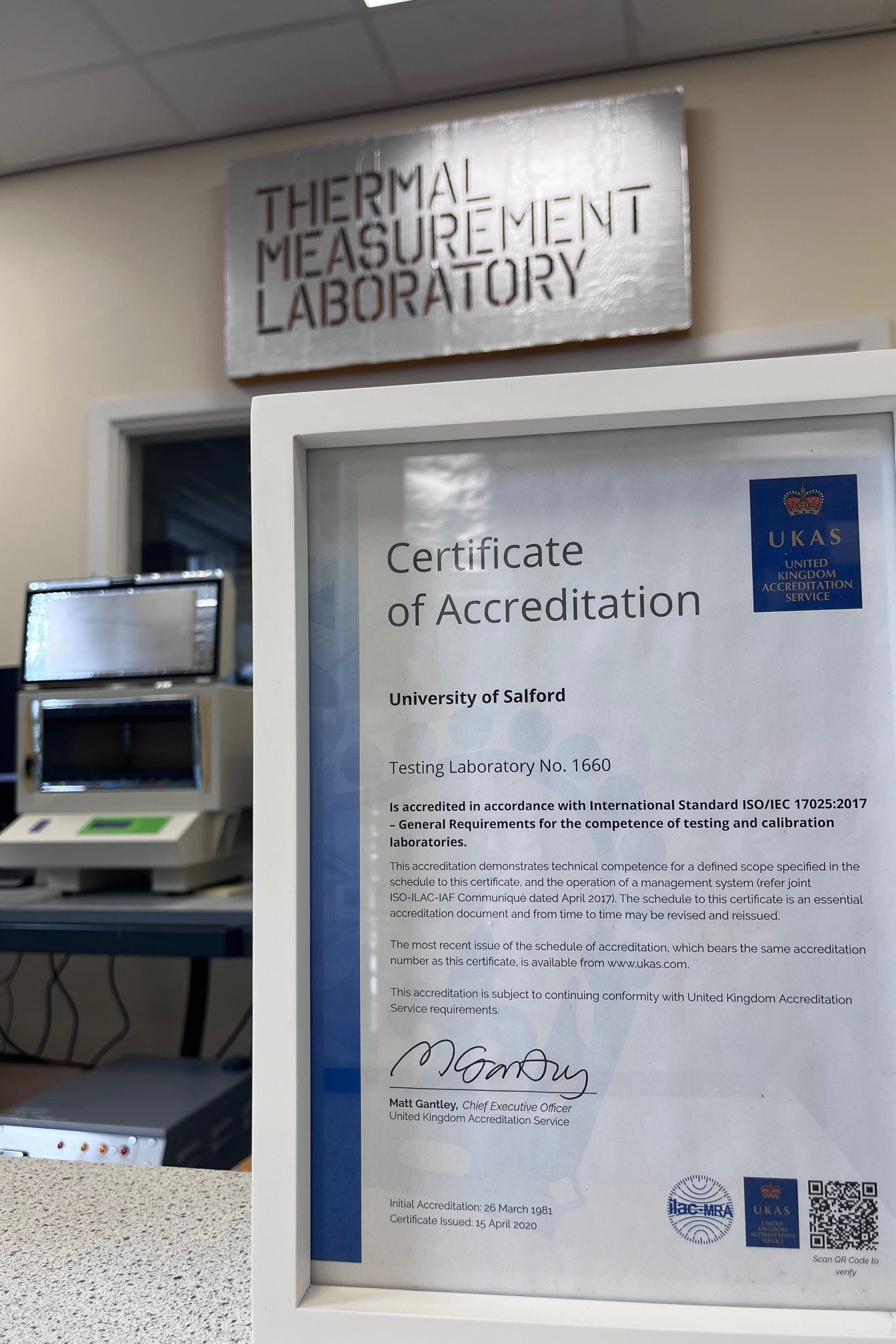
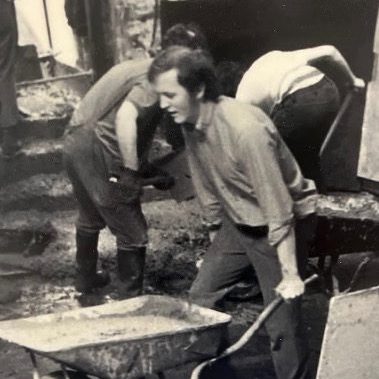
Established by Dr Audrey Stuckes and Dr Anthony Simpson, the laboratory went on to become the first accredited Thermal Measurement Laboratory in the UK in March 1981. At a time when building control officers were grappling with test data discrepancies of over 100%, their work provided a much-needed foundation of accuracy, consistency, and trust for the insulating and construction industries.
From the outset, the lab worked closely with the National Physical Laboratory under the British Calibration Service, which was superseded by the United Kingdom Accreditation Service (UKAS) in 1987, helping to define what “reliable” thermal data should look like. This not only supported better decision-making in building performance and energy efficiency but also positioned the laboratory as a key contributor to the emerging field of building physics.
A defining feature of the laboratory’s early success was the depth and impact of its research. Dr Simpson and Dr Stuckes led pioneering studies into how moisture affects the thermal performance of construction materials including aerated concrete, standard concrete, and mineral fibre cavity wall insulation. Their work demonstrated that moisture content could significantly alter thermal conductivity, providing critical insights for real-world building performance, particularly in the UK’s damp climate. Dr Audrey Stuckes also played a key role in translating complex building physics concepts into accessible education. In 1982, she presented an Open University television programme on BBC One as part of the Mathematical Models and Methods module (MST204, Unit 12), helping to bring principles of heat transfer to a wider audience. This broadcast is available via the Wayback Machine.

In another influential study, they explored how the shape of air inclusions within vermiculite concrete affects heat transfer. This research went beyond theory and led to a collaborative patent with British Petroleum for a thermally insulating filler highlighting the laboratory’s ability to translate fundamental science into practical industrial innovation.
Their expertise also extended into hygrothermal behaviour in building systems, helping to better understand how heat and moisture interact within walls and materials over time. Collectively, their work resulted in over 30 publications and multiple patents, which continue to shape and inform today’s leading practices in insulation testing and material performance.
Patents:
Simpson, A and Stuckes, A D, ‘Thermally insulating filler’, British Patent Case 5030, 1980
Simpson, A and Stuckes, A D, ‘Thermally insulating filler and compositions containing such a filler’, European Patent No.0065410, 11 May 1982
Simpson, A and Fleming, H, ‘Fired clay products’, Provisional Patent Specification Application Publication No. 8802208, 02 February 1988
Simpson, A and Fleming, H, ‘Thermal Brick’, Patent Application No. 8913290, 09 June 1989
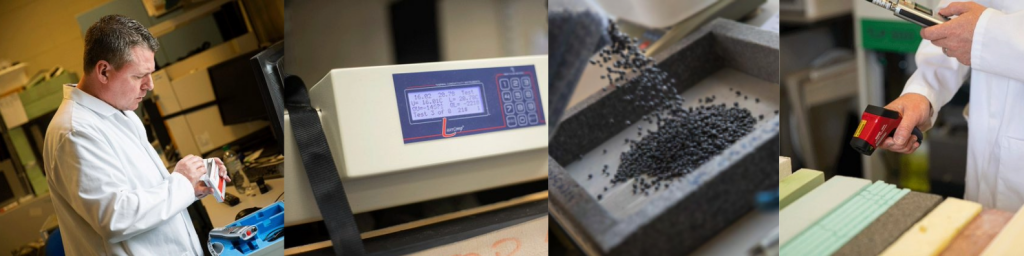
The laboratory’s reputation for precision and innovation ensured it remained busy and financially sustainable from its earliest days, even during challenging economic periods of the early 1980s and the recent pandemic. Over time, it evolved alongside industry standards, transitioning to UKAS accreditation and becoming a recognised authority for testing insulation materials at both national and international levels.
Since becoming part of Energy House Labs in 2019, the Thermal Measurement Laboratory has further solidified its role within a world‑leading centre for energy and building performance innovation. Today, under the guidance of Ian Rattigan, the laboratory continues to evolve and excel.
“The Thermal Measurement Lab has brought a wealth of experience to Energy House Labs. They have been a real addition to the group and all of us became more than the sum of the parts. Tony and Ian brought great experience and quickly became an integral part of the team”.
Prof Will Swan, Director of Energy House Labs
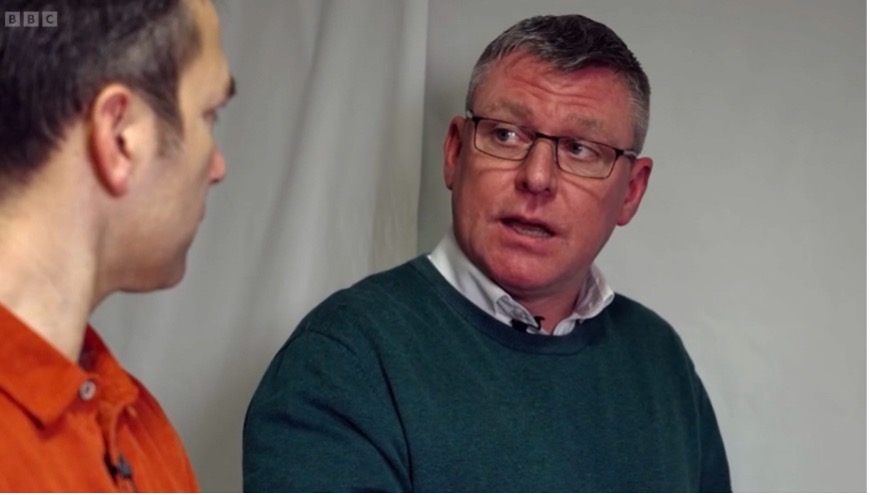
Recent work reflects both continuity and innovation. The team has contributed to research on the thermal performance of modern insulation materials, including expanded polystyrene foams, as well as the real-world effectiveness of thermal paints and coatings in heating-dominated climates work that has even been featured on national television. Ongoing research also includes detailed field studies, such as investigations into the thermal behaviour of traditional thatched roofs, combining modern measurement techniques with heritage buildings.
Looking ahead, the laboratory is expanding its capabilities to include additional testing for insulation certification, alongside developing new methods to better understand and mitigate condensation and mould growth in poorly insulated homes, a critical issue for both energy efficiency and occupant health.
Its enduring strength is firmly rooted in the remarkable legacy shaped by Dr Anthony Simpson. A driving force since its earliest days, Dr Simpson remains integral to the lab’s cutting‑edge research and testing capabilities, embodying the expertise, continuity, and pioneering spirit that continues to define the laboratory’s reputation. We are incredibly proud of the Thermal Measurement Laboratory and the people whose dedication underpins its success. For 45 years, the lab has combined scientific rigour with real-world impact shaping national standards, supporting industry, and advancing knowledge in building performance.
As part of Energy House Labs, and with recent honours such as the Queen Elizabeth Prize for Education, the future looks every bit as inspiring as the past.
Here’s to the next 45 years of innovation, collaboration, and excellence.
Publications & Research Impact
For 45 years, the Thermal Measurement Laboratory has contributed to advancing knowledge in building physics, particularly in understanding the relationship between heat, moisture, and material performance.
🔬 Foundational Research (1980s–1990s)
- The effect of moisture on the thermal conductivity of aerated concrete (1985)
- Moisture factors and thermal conductivity of concrete (1986)
- Aspect of heat transfer mechanisms in porous materials (1986)
- Thermal conductivity of porous materials (1986)
- Thermal conductivity of vermiculite concrete: Effect of inclusion shape (1987)
- Loft Insulants: Effects of air speed on thermal performance (1988)
- Mineral fibre filled cavity wall: Hygrothermal properties (1991)
Discover a comprehensive range of Dr Anthony Simpson’s publications and research outputs through his Google Scholar account. Other publications from the Thermal Measurement Laboratory and Energy House Labs can be viewed via our Research Repository.